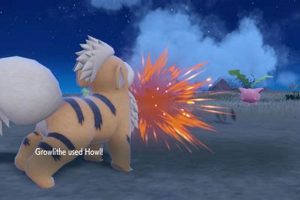



Creatures resembling canines are a recurring design archetype within the Pokmon franchise. These Pokmon often exhibit traits commonly associated with dogs, such as loyalty, playfulness, and keen senses. Examples include Growlithe, known for its fiery mane and protective nature, and Houndoom, a Dark-type Pokmon with a menacing appearance.
The prevalence of canine-inspired Pokmon contributes to the overall appeal and relatability of the franchise. These creatures resonate with players who appreciate the characteristics of real-world dogs. Furthermore, they offer diverse combat capabilities and roles within the game mechanics, ranging from offensive power to supportive abilities. The inclusion of these designs dates back to the initial generations of the franchise, solidifying their enduring presence.
The following discussion will delve into specific categories of canine-inspired Pokmon, exploring their individual attributes, evolutionary lines, and competitive applications. This will provide a more detailed understanding of their significance within the broader Pokmon universe.
Considerations for Trainers of Canine-Inspired Pokmon
Effective utilization of canine-inspired Pokmon requires understanding their strengths and weaknesses. The following guidelines outline essential considerations for trainers seeking to maximize their potential.
Tip 1: Type Matchups: Recognize type advantages and disadvantages. Fire-type examples are vulnerable to Water, Ground, and Rock attacks, while Dark-type examples are weak against Fighting, Bug, and Fairy.
Tip 2: Ability Synergy: Evaluate how abilities complement the Pokmon’s moveset and strategy. Intimidate, for instance, lowers the opponent’s Attack stat, providing a tactical advantage at the start of battle.
Tip 3: Move Pool Coverage: Ensure access to moves that address various opponent types. A diverse move pool prevents being easily countered by a single type weakness.
Tip 4: Evolutionary Stages: Understand when and how evolution occurs. Certain canine-inspired Pokmon require specific items or conditions to reach their final form, unlocking their full potential.
Tip 5: Stat Distribution: Analyze the distribution of stats (Attack, Defense, Speed, etc.) to determine the optimal role in battle. Some excel as physical attackers, while others are better suited for special attacks or defensive roles.
Tip 6: Team Composition: Integrate them strategically into a balanced team. Avoid type overlap and ensure coverage against common threats.
Tip 7: Held Item Optimization: Equip appropriate held items to enhance their capabilities. Life Orb boosts attack power at the cost of HP, while Choice Band locks into a single move but significantly increases Attack.
By implementing these strategies, trainers can effectively leverage the unique strengths and mitigate the weaknesses of canine-inspired Pokmon, improving their overall battle performance and team synergy.
The subsequent sections will examine the evolutionary paths and unique characteristics of specific specimens in more depth, providing a clearer picture of their individual relevance within the ecosystem.
1. Typing

The elemental typing of canine-inspired Pokmon significantly influences their strengths, weaknesses, and overall strategic viability. These typings determine how they interact with other Pokmon in battle and shape their roles within a team composition.
- Elemental Strengths and Weaknesses
A Pokmon’s type dictates its offensive and defensive advantages and disadvantages against other types. A Fire-type canine, for instance, is strong against Grass, Ice, Bug, and Steel-type Pokmon but weak against Water, Ground, and Rock-type Pokmon. This interplay of elemental matchups is crucial for strategic planning.
- Type Combinations
Some canine-inspired Pokmon possess dual typings, which can enhance their strategic utility. A dual-type canine may gain access to a wider range of moves and resistances, but it also inherits the weaknesses of both types. Houndoom, for example, is Dark/Fire type, giving it resistances to Ghost and Dark, but vulnerability to Fighting, Rock, Ground, and Water.
- Move Pool Accessibility
A Pokmon’s type influences the types of moves it can learn. Fire-type canines are more likely to learn Fire-type moves, while Dark-type canines are more likely to learn Dark-type moves. This move pool is critical for determining a Pokmon’s offensive and defensive capabilities and influences its role in battle.
- Status Effects and Immunity
Certain types are immune to specific status conditions or inflict them more easily. For example, Electric-type Pokemon cannot be paralyzed. The typing of canine inspired pokemon affects their vulnerabilty and resistance to status effects, which may dictate the battle outcome.
In summary, understanding the typing of canine-inspired Pokmon is essential for effective training and battle strategy. The elemental strengths, weaknesses, move pool, status effect resistance, and type combinations all determine a Pokmon’s viability and role within a team.
2. Abilities

Abilities represent a crucial component of canine-inspired Pokmon, influencing their battle effectiveness and strategic roles. These inherent traits grant passive effects or trigger under specific conditions, significantly altering gameplay dynamics. A Pokmon’s ability can dictate its viability in competitive scenarios and determine its optimal team composition. For example, Intimidate, a common ability among canine-inspired Pokmon, lowers the Attack stat of opposing Pokmon upon entering the battlefield, providing an immediate tactical advantage. Similarly, Flash Fire, another prevalent ability, renders the Pokmon immune to Fire-type attacks and boosts the power of its own Fire-type moves if hit by one. The choice of ability often determines a Pokmon’s niche and counters.
The synergistic relationship between a canine-inspired Pokmon’s ability and its movepool further enhances its strategic value. A Pokmon with the ability Justified, which raises Attack when hit by a Dark-type move, can effectively counter common Dark-type threats if equipped with appropriate Fighting-type moves. Conversely, a Pokmon with the ability Sand Rush, which doubles its Speed in a Sandstorm, becomes a formidable offensive threat when paired with a Sandstorm-inducing teammate. Practical application involves carefully selecting Pokmon with abilities that complement each other, creating cohesive and powerful teams. Understanding these synergies allows trainers to maximize the potential of their canine-inspired Pokmon in various battle formats.
In summation, Abilities constitute a defining characteristic of canine-inspired Pokmon, shaping their strategic identities and combat capabilities. While some abilities offer immediate benefits, others require specific conditions to activate, demanding careful planning and team coordination. Recognizing the intricate interplay between abilities, typings, and movepools is paramount for trainers seeking to harness the full potential of these creatures and achieve success in competitive battles. A persistent challenge involves predicting and countering opponent’s ability-based strategies, necessitating adaptability and comprehensive knowledge of the Pokmon metagame.
3. Evolutionary Lines

The evolutionary lines of canine-inspired Pokmon are fundamental to their design and strategic viability. These lines dictate the progression of a Pokmon’s stats, abilities, and movepool, shaping its role in battle. Each stage of evolution represents a significant transformation, unlocking new potential and defining the Pokmon’s ultimate capabilities.
- Base Forms and Initial Traits
The base form within an evolutionary line establishes the foundational characteristics of a canine-inspired Pokmon. These forms often exhibit a specific typing, ability, and movepool that define their early-game utility. Growlithe, for instance, starts as a Fire-type Pokmon with the Intimidate or Flash Fire ability, providing early access to Fire-type attacks and potential stat reduction for opponents. The base form’s design elements typically hint at the features and potential of its subsequent evolutions.
- Middle Stages and Transitionary Abilities
The middle stage of evolution represents a transitionary phase where the Pokmon undergoes significant stat growth and may gain access to new abilities and moves. This stage often serves as a bridge between the early-game utility of the base form and the late-game power of the final evolution. In some cases, the middle stage may offer unique strategic options not available in the other forms, such as a different typing or ability combination.
- Final Evolutions and Apex Capabilities
The final evolution within a canine-inspired evolutionary line represents the peak of its potential. These forms typically possess significantly higher stats, access to more powerful moves, and refined abilities that define their role in competitive battles. Arcanine, for example, gains increased offensive stats and access to a wider range of Fire-type attacks upon evolving from Growlithe, solidifying its position as a powerful Fire-type attacker.
- Branching Evolutions and Alternate Paths
Some canine-inspired Pokmon feature branching evolutions, where the base form can evolve into different final forms depending on specific conditions or items used. These branching evolutions offer alternative strategic paths and allow trainers to customize their Pokmon to suit their preferred playstyle. The existence of multiple final forms adds depth to the evolutionary line and provides greater flexibility in team building.
The evolutionary lines of canine-inspired Pokmon are integral to their identity and strategic role within the franchise. Each stage of evolution unlocks new capabilities and defines the Pokmon’s strengths and weaknesses. Understanding these evolutionary paths is crucial for trainers seeking to maximize the potential of their canine-inspired companions and achieve success in battles.
4. Move sets

The strategic application of canine-inspired Pokmon is intrinsically linked to their available move sets. These move sets, encompassing a range of attack types and support options, determine a Pokmon’s role in battle and its overall utility within a team composition. The selection and utilization of appropriate moves are crucial for maximizing a Pokmon’s potential and countering opposing strategies.
- Type Coverage and Offensive Potential
Move sets provide type coverage, enabling canine-inspired Pokmon to effectively target various opponents. Access to moves of different types allows for exploiting weaknesses and achieving super-effective damage. For example, a Fire-type canine possessing a Rock-type move gains a significant advantage against Water-type opponents, mitigating a primary weakness. Offensive potential is directly correlated with the power and accuracy of available moves, influencing damage output and battle control.
- Status Conditions and Disruptive Tactics
Certain moves inflict status conditions, such as paralysis, burn, or poison, which can cripple opponents and disrupt their strategies. Canine-inspired Pokmon with access to moves that induce these conditions can gain a tactical edge, weakening or disabling key threats. The strategic application of status moves requires careful timing and prediction to maximize their impact on the battle’s outcome. For instance, utilizing a move that inflicts burn reduces the opponent’s Attack stat, indirectly increasing the damage output of some canine-inspired Pokmon.
- Support Moves and Team Synergy
Move sets may include support moves that enhance the Pokmon’s own capabilities or bolster the team’s overall effectiveness. These moves can raise stats, provide healing, or create defensive barriers. Canine-inspired Pokmon with access to support moves can function as valuable team players, providing crucial assistance to their allies. Moves that increase speed increase the odds of executing a faster attack.
- Signature Moves and Unique Strategies
Some canine-inspired Pokmon possess signature moves that are unique to their species or evolutionary line. These moves often offer special effects or enhanced power, providing a distinctive strategic advantage. Signature moves can define a Pokmon’s identity and create opportunities for innovative battle tactics. One example of unique strategies could be using a move to copy the opponent pokemon’s move or stat.
The composition of a canine-inspired Pokmon’s move set directly determines its combat effectiveness and strategic role. The inclusion of diverse move types, status condition inflictors, support options, and signature moves contributes to a well-rounded and versatile battle style. Proper analysis and customization of a Pokmon’s move set are essential for maximizing its potential and adapting to various competitive scenarios. Understanding and adjusting the move set to specific circumstances is a necessity to excel.
5. Base stats
Base stats represent a fundamental characteristic of canine-inspired Pokmon, directly influencing their combat effectiveness and strategic roles. These numerical values, assigned to Hit Points (HP), Attack, Defense, Special Attack, Special Defense, and Speed, dictate a Pokmon’s inherent strengths and weaknesses. The distribution of base stats determines its suitability for specific roles within a team composition, shaping its offensive, defensive, or supportive capabilities. For instance, Arcanine exhibits a high Attack stat, positioning it as a physical attacker, while other canine designs like defensive-oriented support units showcase higher Defense or Special Defense. This direct correlation between base stat distribution and combat function makes understanding these values paramount for effective team building and battle strategy.
Analyzing the base stats of canine-inspired Pokmon enables trainers to make informed decisions regarding their training and deployment. A Pokmon with high Speed and Attack can effectively function as a sweeper, rapidly defeating opponents before they can retaliate. Conversely, a Pokmon with high HP and Defense may serve as a wall, absorbing damage and disrupting opposing strategies. Consider Houndoom, characterized by a high Special Attack stat. This feature, in combination with moves such as Dark Pulse and Fire Blast, is crucial to capitalize on their offensive potential. Recognizing these stat-based strengths is critical for optimizing a Pokmon’s moveset and held item selection, creating a synergistic combination for maximum impact. Properly interpreting this relationship is crucial for effective training.
In conclusion, base stats are a critical determinant of a canine-inspired Pokmon’s battle capabilities and role within a team. The distribution of these stats dictates its strengths, weaknesses, and overall strategic utility. Understanding base stats enables trainers to make informed decisions about training, move selection, and team composition, maximizing the potential of these creatures and achieving success in battle. The enduring challenge lies in adapting to varying opponent strategies and anticipating changes in the competitive metagame, requiring continuous assessment and adjustment of team compositions to maintain optimal performance.
6. Design origins
The design origins of canine-inspired Pokmon are integral to their identities, influencing their aesthetic appeal, move sets, and even their typings. These origins draw from a diverse range of real-world canines, mythology, and folklore, creating creatures that resonate with players on both a visual and cultural level. The selection of specific canine breeds or archetypes directly impacts a Pokmon’s perceived characteristics and strategic role. For example, the design of Arcanine clearly draws from the imagery of majestic Chinese guardian lions, imbuing it with a sense of power, nobility, and protection, traits that are reflected in its high Attack stat and access to moves like Extreme Speed.
Further analysis reveals that design choices often extend beyond mere visual inspiration. The dual-typing of Houndoom, Dark/Fire, is rooted in its Cerberus-inspired design, associating it with both hellish flames and the menacing nature of underworld guardians. The inclusion of elements from folklore and mythology enhances the Pokmon’s narrative depth, contributing to a richer and more engaging gaming experience. Practical application of this understanding involves recognizing the thematic connections between a Pokmon’s design and its in-game attributes, informing team-building strategies and providing insight into potential move sets. Knowledge of design origins enables players to anticipate a pokemon’s moves or ability.
In summary, the design origins of canine-inspired Pokmon are not merely aesthetic choices; they are fundamental to their identities, strategic roles, and narrative significance. The careful integration of real-world canine traits, mythological influences, and folklore elements creates a diverse and compelling cast of creatures that resonate with players. Recognizing and appreciating these design origins enhances the overall gaming experience, adding depth and context to the strategic application of these Pokmon in battle. The ongoing challenge lies in continually adapting to new designs and interpretations of canine archetypes, ensuring a dynamic and engaging Pokmon universe.
Frequently Asked Questions Regarding Canine-Inspired Pokmon
This section addresses common inquiries and misconceptions concerning Pokmon that exhibit canine characteristics. The information provided is intended to clarify their categorization, attributes, and strategic applications within the Pokmon universe.
Question 1: What criteria define a Pokmon as “canine-inspired”?
A Pokmon is considered canine-inspired if its design, behavioral traits, and overall aesthetic strongly resemble those of real-world canines, including domestic dogs, wolves, foxes, and jackals. Key features include anatomical similarities, characteristic vocalizations, and exhibited behaviors such as loyalty or pack hunting.
Question 2: Are all quadrupedal Pokmon considered canine-inspired?
No. While many canine-inspired Pokmon are quadrupedal, not all quadrupedal Pokmon qualify. The defining factor is a clear resemblance to canine species, not simply possessing four legs. Bovine, feline, and equine Pokmon, for example, are also quadrupedal but do not share canine characteristics.
Question 3: How does the canine inspiration impact a Pokmon’s battle capabilities?
The design inspiration frequently influences a Pokmon’s typing, move set, and abilities. Canine characteristics such as speed, strength, or loyalty may translate into specific in-game attributes. A Pokmon inspired by a protective breed, for instance, may possess higher Defense stats or abilities that support its allies.
Question 4: Are canine-inspired Pokmon limited to specific types?
No. Canine-inspired Pokmon span a wide range of types, including Fire, Dark, Normal, and Electric. The canine design archetype is versatile and can be adapted to various elemental affiliations, providing diverse strategic options.
Question 5: Does the popularity of dogs in real life influence the design of these Pokmon?
It is reasonable to infer a correlation between the enduring popularity of dogs and the prevalence of canine-inspired Pokmon. The familiarity and positive associations with canines contribute to their appeal and integration into the game. However, specific design choices are also guided by strategic considerations and the need for diverse character archetypes.
Question 6: Is there a definitive list of all Pokmon classified as canine-inspired?
A strict, universally accepted list does not exist. The classification is subjective and open to interpretation. However, commonly cited examples include Growlithe, Arcanine, Houndour, Houndoom, Poochyena, Mightyena, Boltund, and Lycanroc (Midday Form). Community resources and Pokdex entries can provide further insight.
In summary, the design inspiration from canines profoundly impacts a Pokmon’s identity, strategic function, and overall appeal. Understanding these design origins provides valuable context for appreciating their roles within the Pokmon universe.
The next section will delve into detailed analysis of the battle capabilities and strategic synergies of selected canine-inspired Pokmon, providing practical guidance for their effective use.
Conclusion
The examination of Pokmon exhibiting canine traits reveals their multifaceted integration into the franchise. Their designs, drawing inspiration from real-world canines and mythology, influence their typings, abilities, move sets, and base stats. This interconnectedness shapes their strategic roles and combat effectiveness within the game.
Understanding the design origins, evolutionary lines, and battle capabilities of these Pokmon enhances appreciation for their significance. Continued exploration and analysis of future canine-inspired additions will provide a more complete understanding of their place within the evolving Pokmon universe.