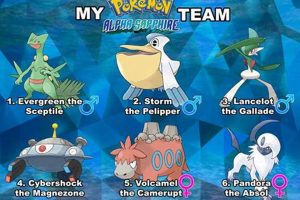



The process of constructing a party for the Game Boy Advance title, Pokmon Emerald, often involves careful consideration of Pokmon types, individual statistics, and move sets. This strategic selection is crucial for overcoming the game’s challenges, including Gym Leaders, the Elite Four, and various in-game encounters. For example, a team might incorporate a Water-type Pokmon to counter Ground and Rock types, or a Fire-type to deal with Grass and Ice types.
The strategic composition of a team offers several benefits, most notably increased success in battles and efficient progression through the game. Historically, players relied on trial and error or consulted printed guides to determine optimal team configurations. A well-balanced party, with a diverse range of types and complementary abilities, is essential for overcoming the varied challenges presented within the Hoenn region.
Further discussion will focus on key considerations for team selection, effective type matchups, and recommended Pokmon choices for building a powerful and adaptable group capable of conquering the Pokmon Emerald adventure.
Team Composition Strategies
Optimal party construction in Pokmon Emerald necessitates strategic considerations to navigate the challenges presented by Gym Leaders, the Elite Four, and other trainers. Prioritize type diversity and move set coverage to ensure effective responses to varied opponents.
Tip 1: Type Coverage is Paramount: A team that relies too heavily on one or two types is vulnerable to specific counters. Aim for a party with diverse elemental strengths to address a wide range of opposing Pokmon. For instance, pairing a Water-type with an Electric-type and a Grass-type provides coverage against common threats.
Tip 2: Consider Dual-Typing: Dual-type Pokmon can offer advantages and disadvantages. A Pokmon with multiple types may gain resistance to certain attacks but also acquire new weaknesses. Analyze the type chart carefully when selecting dual-type members for the group.
Tip 3: Speed Matters: In many battles, the first Pokmon to attack gains a significant advantage. Prioritize members with high Speed stats, or moves that increase Speed, to secure the initiative. A fast Pokmon can quickly eliminate weaker opponents or inflict status conditions.
Tip 4: Status Effects are Powerful: Inflicting status ailments like paralysis, poison, burn, or sleep can cripple opponents and dramatically shift the momentum of a battle. Include at least one Pokmon with reliable status-inducing moves.
Tip 5: Balance Offense and Defense: While offensive power is important, neglecting defensive capabilities can lead to swift defeats. Incorporate a blend of Pokmon with high Attack/Special Attack and high Defense/Special Defense to withstand incoming damage.
Tip 6: Adapt to the Region: The Hoenn region has a high prevalence of Water-type Pokmon. Consider a strong Electric-type and Grass-type in the initial team composition to counter this advantage of opponents.
Tip 7: Include a HM User: While not ideal to dedicate a slot, having a party member that can learn multiple Hidden Machines (HMs) can ease travel and exploration considerably. Pokmon like Swampert, capable of learning Surf, Waterfall, and Strength, are particularly valuable.
Effective party construction necessitates balancing offensive and defensive capabilities, prioritizing type coverage, and adapting to the specific challenges of the Hoenn region. Strategic selection of members, accounting for speed, status effects, and the inclusion of a dedicated HM user, increases chances of success.
The subsequent sections will provide recommended Pokmon choices and example team compositions suitable for various play styles and progression points throughout the Pokmon Emerald campaign.
1. Type Matchup Analysis

Type matchup analysis constitutes a foundational element in the strategic selection and arrangement of a successful Pokmon Emerald party. This analysis directly impacts the efficiency with which a player navigates battles, as type matchups determine damage multipliers, resistances, and immunities. Constructing a viable group without diligent consideration of type interactions often leads to significant disadvantages against opposing trainers and wild Pokmon. For example, neglecting to include an Electric-type Pokmon leaves the team vulnerable to Water-type attacks, prevalent throughout the Hoenn region. Conversely, the inclusion of a Grass-type mitigates Water-type damage but simultaneously introduces a weakness to Fire-type attacks, necessitating further team diversification.
The practical application of type matchup analysis extends beyond simple attack effectiveness. A well-informed player understands how type interactions influence defensive capabilities. For instance, a dual-type Pokmon might possess a combination of resistances and weaknesses not immediately apparent. A Ground/Rock-type, such as Golem, gains immunity to Electric-type attacks but becomes quad-weak to Water and Grass-type attacks. This necessitates a tactical approach to battle, including strategic switching to maximize type advantages and minimize vulnerabilities. In practice, a player might switch out Golem when facing a Water-type Pokmon to preserve its health and deploy a more advantageous type.
Effective use of type matchup analysis facilitates efficient progression through Pokmon Emerald. Understanding type matchups allows players to develop a party capable of overcoming a broad spectrum of challenges, particularly the specialized Gym Leaders and the Elite Four. Failure to account for type interactions results in increased reliance on healing items, slower progression, and a diminished overall experience. Prioritizing this analysis is therefore an essential skill for maximizing battle effectiveness.
2. Move Set Diversity

Move set diversity is a critical factor in effective team construction within Pokmon Emerald. A team lacking diverse offensive and supportive capabilities faces significant disadvantages against the wide variety of opponents encountered throughout the game.
- Type Coverage through Moves
A Pokmon may be inherently limited by its typing. However, its move pool can compensate for these weaknesses. A Water-type Pokmon learning an Ice-type move, for example, can effectively counter Grass-type adversaries. Diversifying move types within a team ensures it is not easily walled by Pokmon resistant or immune to a primary attack type.
- Status Condition Infliction
Beyond direct damage, inflicting status conditions such as paralysis, poison, burn, or sleep significantly impacts battle outcomes. A team that relies solely on damaging moves lacks the ability to cripple opponents or disrupt their strategies. Status moves provide crucial tactical advantages, particularly against challenging foes or in protracted battles. For example, a team with no access to paralysis may struggle against fast-attacking opponents.
- Buffing and Debuffing Capabilities
Moves that increase a Pokmon’s own stats (buffs) or decrease the stats of opposing Pokmon (debuffs) provide another layer of strategic depth. Access to moves like Swords Dance (Attack buff) or Screech (Defense debuff) can dramatically alter the course of a battle. A team lacking stat-altering moves misses opportunities to amplify its strengths or exploit enemy weaknesses, potentially leading to slower battle resolution or outright defeat.
- Utility and Healing Moves
Moves outside of direct attack and status infliction can also significantly contribute to a team’s success. Healing moves like Recover or Wish provide sustainability, while moves like Protect or Detect offer temporary invulnerability. Moves like Dig can grant turns to avoid attacks from enemies. Furthermore, moves with effects during overworld exploration, such as Cut, can have an impact on how a team must be constructed. These elements add tactical flexibility and increase the survivability of the team.
In conclusion, move set diversity addresses fundamental aspects of “pokemon emerald team builder”. A Pokmon Emerald team that incorporates diverse moves, including varied attack types, status infliction, stat alteration, and utility options, is far more adaptable and resilient than one relying solely on brute force. The strategic selection of moves directly contributes to the overall effectiveness of the team and its ability to overcome the myriad challenges within the Hoenn region.
3. Stat Distribution Balance

Stat distribution balance is a critical consideration in team composition for Pokmon Emerald. A team overly focused on a single statistic, such as Attack or Speed, becomes vulnerable to strategies that exploit its weaknesses. A balanced stat distribution promotes resilience, adaptability, and overall effectiveness in diverse combat scenarios.
- Offensive and Defensive Equilibrium
A viable team necessitates a blend of offensive power and defensive resilience. An overreliance on high Attack or Special Attack statistics, without corresponding investments in Defense, Special Defense, or HP, can lead to swift defeats. Consider incorporating members capable of withstanding significant damage while simultaneously delivering substantial counterattacks. For example, a team comprised solely of frail, fast attackers is susceptible to priority moves and status conditions.
- Speed as a Strategic Advantage
While raw power is valuable, Speed determines the order of attacks in most combat situations. A team with a favorable Speed distribution can control the tempo of a battle, allowing it to inflict status conditions, set up stat boosts, or eliminate threats before they can retaliate. However, complete reliance on Speed can be detrimental; Pokmon with high Speed but low defenses are easily incapacitated by strong attacks. Balance is key.
- Specialized Roles and Stat Allocation
Different team members can fulfill specialized roles, which influence their optimal stat distributions. A dedicated wall, intended to absorb damage and inflict status conditions, benefits from high HP, Defense, and Special Defense. An offensive sweeper, designed to quickly eliminate opponents, requires high Attack or Special Attack and Speed. Recognizing and accommodating these diverse roles optimizes team synergy.
- Adaptive Team Building and Stat Compromises
Creating an ideal team requires balancing individual Pokmon strengths with team-wide strategic priorities. In certain situations, it may be necessary to compromise on a specific stat to enhance another, or to cover a critical weakness in the team’s overall composition. For example, using a bulky water type on a team may reduce the team’s speed but adds to its overall bulk and ability to take hits.
In summary, stat distribution balance directly impacts the overall effectiveness of any Pokmon Emerald team. Prioritizing a blend of offensive and defensive capabilities, strategically leveraging Speed, allocating stats based on specialized roles, and making informed compromises contribute to a resilient, adaptable, and ultimately more successful team. This considered approach to building a team increases a player’s chances of successfully navigating the challenges of the Hoenn region.
4. Regional Availability

The availability of Pokmon within specific geographical areas of the Hoenn region significantly influences team construction strategies. The distribution of Pokmon species throughout the game is not uniform; certain creatures are exclusive to specific locations, requiring players to explore various routes, caves, and bodies of water to assemble a diverse and effective group. This geographical constraint dictates the accessibility of particular type combinations and individual statistics early in the game, impacting team composition. For example, the early acquisition of a Mudkip provides a significant advantage against the first Gym Leader, Roxanne, due to its Water typing and availability as a starter Pokmon, whereas obtaining a Grass-type before facing Roxanne requires more dedicated searching and may involve a weaker Pokmon overall.
Regional limitations affect decisions throughout the playthrough. Encountering a rare or powerful Pokmon in a specific location may prompt a player to alter their existing team composition to capitalize on this opportunity, even if it deviates from their initial plan. The necessity of acquiring Pokmon capable of learning Hidden Machines (HMs) further influences team construction based on regional access. For example, the requirement of Surf to navigate vast stretches of water necessitates including a Water-type Pokmon in the party, whether or not it perfectly aligns with the player’s intended team archetype. Moreover, certain breeding combinations are only accessible after unlocking specific areas of the region. Regional accessibility thus provides an impact upon team construction choices.
In summary, the regional availability of Pokmon serves as a primary constraint and driver of team composition in Pokmon Emerald. This distribution affects early-game advantages, long-term strategic planning, and the inclusion of Pokmon required for navigation. The challenges of team construction are therefore intertwined with the exploration and understanding of the Hoenn region’s diverse ecosystems, with a player’s options limited to their progress. This understanding directly contributes to a player’s success.
5. Evolutionary Stages

Evolutionary stages constitute a central element of any successful “pokemon emerald team builder” strategy. A Pokmon’s strength, movepool, and ultimately its effectiveness in battle, are directly linked to its current stage of evolution. Early-game planning must consider the long-term potential of undeveloped Pokmon, balancing immediate needs with future power. The choice between a powerful, fully-evolved Pokmon available later versus a weaker, less-evolved Pokmon obtainable earlier hinges on understanding the progression timeline and the resources (experience, items) needed to facilitate evolution. For example, Ralts, a Psychic-type Pokmon, is relatively weak when first encountered, but its final evolution into Gardevoir makes it a valuable asset on any team. Delaying evolution, in some situations, can permit earlier access to key moves, necessitating careful decision making.
The strategic importance of evolutionary stages extends beyond raw statistics. Each stage often brings access to new moves, altering a Pokmon’s strategic role within the party. A Nuzleaf, for instance, can learn moves valuable for early and mid-game progression, but it must evolve into Shiftry to access its full potential. Furthermore, the availability of evolutionary stones, such as the Water Stone or Leaf Stone, can significantly accelerate the development of certain Pokmon, shifting the power dynamic within the team earlier than anticipated. Evolutionary Stones thus require considering location to find in the region.
Understanding evolutionary stages is imperative for optimizing team performance. Failing to account for the time and resources required to evolve Pokmon can lead to underpowered teams and stalled progression. By carefully assessing the long-term potential of each team member and strategically managing evolution, players can ensure a balanced and effective team capable of overcoming the challenges presented in Pokmon Emerald. Therefore, team construction strategy requires consideration of these evolutionary stages for optimal success.
Frequently Asked Questions
This section addresses common inquiries regarding team building strategies for the Pokmon Emerald game. The information provided aims to clarify key concepts and offer practical guidance for constructing an effective and balanced team.
Question 1: What constitutes a well-balanced team composition?
A well-balanced team typically encompasses a diverse range of type matchups, offensive and defensive capabilities, and strategic move sets. Avoid over-reliance on a single type, ensure coverage against common threats, and incorporate both physical and special attackers.
Question 2: How important is type coverage in Pokmon Emerald?
Type coverage is crucial. A team with limited type coverage becomes vulnerable to opponents with advantageous matchups. Strive for a team that can effectively counter a variety of enemy types.
Question 3: What role do Hidden Machines (HMs) play in team construction?
Hidden Machines are necessary for navigating certain areas of the Hoenn region. Include at least one Pokmon capable of learning essential HMs such as Surf, Waterfall, and Strength, even if it compromises the team’s overall strategic composition. These HMs can be useful for some exploration.
Question 4: Should the player focus on early-game strength or long-term potential?
A balance between early-game utility and long-term potential is optimal. Select some Pokmon that provide immediate advantages while also investing in Pokmon with higher ceilings as they evolve. Evaluate the availability of evolution stones or other facilitating items.
Question 5: How critical is Speed in battle dynamics?
Speed is a significant factor, but not the sole determinant of success. While faster Pokmon often strike first, raw power, type matchups, and strategic move selection can overcome a speed disadvantage. Building a team around only speed can be risky.
Question 6: How does regional availability affect team choices?
Regional availability dictates which Pokmon are accessible at various points in the game. Adapt the team composition based on the available resources and adjust your plans when encountering rare or powerful specimens. These choices will be an integral point to build a successful team.
Effective team construction involves considering a multitude of factors, including type coverage, HM requirements, evolutionary stages, and statistical balance. This comprehensive approach optimizes success within the Hoenn region.
The following section provides practical examples of team compositions suitable for various stages of the Pokmon Emerald adventure.
Conclusion
The preceding discussion has thoroughly examined various facets of effective “pokemon emerald team builder” practices. This exploration has highlighted the crucial roles of type matchup analysis, move set diversity, stat distribution balance, regional availability, and evolutionary stages in crafting a successful party. The integration of these considerations facilitates a higher probability of overcoming the challenges within the Hoenn region, leading to a more fulfilling gaming experience.
Strategic party composition remains a cornerstone of success in Pokmon Emerald. A comprehensive understanding of these principles empowers players to approach team building with greater precision and foresight. Continued application of these strategies will contribute to improved performance and a deeper appreciation for the intricacies of the game.


![Build the Best AAA Team Pokemon Showdown [Guide] | Pokémon Guide & Updates – Latest News, Games, Cards, and Tips](https://pokepolitan.com/wp-content/uploads/2026/02/th-53-300x200.jpg "Build the Best AAA Team Pokemon Showdown [Guide] Pokémon Guide & Updates – Latest News, Games, Cards, and Tips")