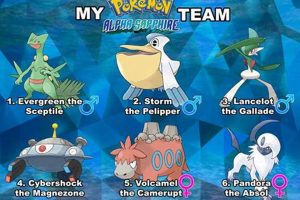



A structured framework aids in the strategic creation of a group of Pokmon intended for battles or other in-game activities. This framework typically includes considerations for type coverage, move sets, and individual Pokmon roles within the group dynamic. An example might involve outlining a team with a designated physical attacker, a special attacker, a wall, and support Pokmon.
Employing such a framework facilitates efficient team building and maximizes potential synergy among team members. This structured approach can be particularly useful for players aiming to optimize performance in competitive battling or challenging in-game content. Historically, the concept of a well-balanced group has been a core tenet of successful strategies within the franchise.
The following sections will delve deeper into specific strategies and considerations for building effective groups, covering diverse approaches, key components, and methods for adaptation and optimization.
Strategic Considerations for Pokmon Group Construction
The following outlines crucial considerations for developing a well-structured group, focusing on maximizing synergy and addressing potential weaknesses.
Tip 1: Type Coverage is Paramount: A successful group mitigates vulnerabilities by encompassing a wide range of elemental types. This reduces the impact of super-effective attacks and allows for greater offensive flexibility.
Tip 2: Synergy Enhances Effectiveness: Select Pokmon whose abilities and move sets complement each other. For example, a Pokmon with the Drizzle ability can power up Water-type attacks, benefiting Water-type teammates.
Tip 3: Define Roles for Each Member: Clearly delineate the function of each Pokmon. Designate physical attackers, special attackers, defensive walls, and support roles to create a balanced and adaptable dynamic.
Tip 4: Move Set Optimization is Key: Equip each Pokmon with a diverse move set that addresses both offensive and defensive needs. Consider status moves, recovery moves, and moves that provide utility.
Tip 5: Speed Control Provides Advantage: Incorporate methods to control the battle’s pace. This can be achieved through high-speed Pokmon, priority moves, or abilities that manipulate Speed.
Tip 6: Item Selection Augments Performance: Choose held items that enhance each Pokmon’s specific role. Life Orb increases damage output, while Leftovers provide passive recovery.
Tip 7: Team Preview Analysis is Essential: Before each battle, carefully analyze the opponent’s revealed group to anticipate threats and adjust strategies accordingly.
These considerations are vital for establishing a robust and versatile Pokmon group capable of handling diverse challenges. Prioritizing type coverage, synergy, defined roles, optimized move sets, speed control, and strategic item choices contributes to overall efficacy.
The subsequent section will discuss advanced strategies for refinement and adaptation, ensuring long-term success.
1. Type Matchup Dynamics

Type matchup dynamics are a cornerstone of strategic Pokmon group construction, dictating offensive and defensive capabilities. A well-structured group leverages these dynamics to maximize damage output while minimizing vulnerabilities. Understanding these interactions is crucial for assembling a competitive force.
- Offensive Coverage
Offensive coverage refers to the ability of a Pokmon group to effectively target a wide range of opposing types for super-effective damage. A lack of coverage can leave a team vulnerable to specific Pokmon or strategies. For example, a team lacking Ground-type moves may struggle against Electric-types. A balanced offensive approach mitigates this risk.
- Defensive Resilience
Defensive resilience involves minimizing weaknesses to common attack types. Teams with multiple shared weaknesses are easily exploited. For example, a group consisting predominantly of Fire-types is highly vulnerable to Water and Ground attacks. Strategic type diversification enhances overall survivability.
- Type Synergies
Certain type combinations offer inherent advantages due to complementary resistances and immunities. For example, a Fire/Water pairing covers the weaknesses of each other. Such synergies create a more robust defensive profile and enhance overall group cohesion.
- Predictive Analysis
Anticipating an opponent’s group composition and type matchups is essential for tactical decision-making. Predicting the moves an opponent is likely to use based on type matchups enables strategic switching and move selection, increasing the chances of victory.
The effective management of type matchup dynamics is integral to the success of any Pokmon group. Careful consideration of offensive coverage, defensive resilience, type synergies, and predictive analysis allows for the creation of a formidable and adaptable force, directly impacting overall competitiveness and strategic depth within the franchise.
2. Role Specialization

Role specialization is a fundamental aspect of the framework, significantly impacting the overall efficacy of any strategic grouping. This specialization entails assigning distinct functions to individual members, optimizing their strengths while minimizing vulnerabilities, contributing to a well-rounded and adaptable force.
- Dedicated Physical Attacker
A physical attacker focuses on dealing damage using physical moves, capitalizing on a high Attack stat. Examples include Pokmon like Excadrill or Dragonite. Their role is to pressure the opposing group with powerful physical attacks, often targeting defensively weaker members. In a defined framework, the physical attacker ensures consistent physical damage output.
- Dedicated Special Attacker
A special attacker specializes in dealing damage using special moves, leveraging a high Special Attack stat. Examples include Pokmon like Volcarona or Tapu Koko. Their purpose is to break through physically defensive walls and threaten foes with special moves. Within a well-defined structure, the special attacker ensures special damage output and provides coverage against physically bulky opponents.
- Defensive Wall
A defensive wall is designed to absorb damage and disrupt the opposing group’s strategy. These Pokmon possess high Defense or Special Defense stats and are often equipped with recovery moves. Examples include Toxapex or Ferrothorn. Their responsibility is to withstand attacks, set up entry hazards, or provide support through status moves. In a defined grouping, the defensive wall provides resilience and control.
- Support Role
The support role encompasses various functions, including healing, status infliction, and stat boosting. Examples include Clefable or Blissey. Their goal is to enhance the team’s overall performance by providing utility and disrupting the opponent. Within a structured grouping, the support member ensures the team’s survival and creates opportunities for offensive members.
Integrating these specialized roles is critical to achieving a balanced and versatile group within the framework. The combination of physical and special attackers, defensive walls, and support members enables a comprehensive approach to battling, addressing diverse threats and maximizing strategic flexibility. Furthermore, adaptability and synergy amongst specialized roles enhance the overall efficacy.
3. Move Set Diversity

The strategic advantage derived from a well-defined framework is significantly amplified by the implementation of move set diversity. Within this framework, each member benefits from a varied arsenal of attacks and support maneuvers. This diversity mitigates predictability and enhances adaptability in various battle scenarios. A group lacking diverse move sets becomes predictable, vulnerable to type-based counters and specific strategic maneuvers. For instance, a Pokmon primarily reliant on single-type attacks can be easily walled by a resistant type, highlighting the critical need for secondary and tertiary move options within a solid framework.
Consider a hypothetical group adhering to a robust plan, but with limited offensive options. A Water-type Pokmon with only Water-type attacks would be rendered ineffective against opposing Water-types. However, if the same Pokmon has access to Ice Beam, it can overcome this limitation. Similarly, a defensive wall benefits from moves such as Toxic or Will-O-Wisp to inflict status conditions, further disrupting the opponent. Diversifying a move pool is more than simply choosing varied types; it also involves selecting moves with different utility, such as stat boosts, recovery, or priority, all reinforcing the framework’s structural integrity.
In conclusion, move set diversity is not merely an addendum to a well-defined plan; it is an indispensable component. It ensures comprehensive coverage, enhances adaptability, and reduces susceptibility to predictable counters. The absence of such diversity weakens the entire strategy, regardless of the individual strengths of Pokmon within the group, thus underlining its critical integration into the overall plan.
4. Stat Distribution

Within a structured framework, meticulous consideration of stat distribution is paramount. It directly influences the performance and effectiveness of individual members and, consequently, the overall cohesiveness of the entire strategic formation.
- Base Stat Allocation and Role Fulfillment
The allocation of base stats dictates a Pokmon’s inherent strengths and weaknesses, directly impacting its ability to fulfill a designated role. A physical attacker requires a high Attack stat, whereas a special attacker necessitates a substantial Special Attack stat. A defensive wall must possess high Defense or Special Defense values. Mismatched stat allocation compromises a Pokmon’s efficacy within a structured framework, hindering its ability to perform its intended function. For example, assigning a support role to a Pokmon with low HP and defensive stats renders it unable to effectively provide utility.
- Investment in Individual Values (IVs) and Effort Values (EVs)
Individual Values (IVs) and Effort Values (EVs) further refine a Pokmon’s stat distribution, allowing for customization to specific needs. IVs are fixed, influencing potential, while EVs are earned through battle, enabling targeted stat boosts. Strategic investment in EVs can compensate for base stat deficiencies or amplify existing strengths. A defensive wall might invest primarily in HP and Defense EVs to maximize survivability, while a special attacker might focus on Special Attack and Speed. Proper EV investment optimizes a Pokmon’s performance within its defined framework.
- Nature Selection and Stat Modification
A Pokmon’s Nature influences its stat growth, boosting one stat while hindering another. Careful selection of a Nature that complements a Pokmon’s role is essential for maximizing its potential. For example, a Modest Nature increases Special Attack but reduces Attack, making it ideal for special attackers. A Bold Nature increases Defense but reduces Attack, suitable for defensive walls. Aligning a Pokmon’s Nature with its intended function enhances its effectiveness within a carefully structured framework.
- Speed Tier Considerations and Strategic Implications
Speed is a critical stat that determines turn order, influencing a Pokmon’s ability to attack first, set up entry hazards, or provide support. Analyzing speed tiersthe range of speed stats achievable by different Pokmonallows for strategic positioning and outspeeding key threats. Investing in Speed EVs can ensure a Pokmon outspeeds crucial opponents, providing a significant advantage. A framework must account for Speed distribution to control the battle’s pace and execute strategic maneuvers effectively.
In conclusion, the intricate interplay between base stat allocation, IV/EV investment, Nature selection, and speed tier considerations underscores the importance of meticulous stat distribution within a strategic framework. The optimization of these elements ensures individual members are equipped to effectively fulfill their designated roles, contributing to the overall success of the team.
5. Synergistic Abilities
The effectiveness of a structured group is heavily influenced by the presence of synergistic abilities among its members. These abilities, when combined, create effects that are greater than the sum of their individual contributions. The framework necessitates careful selection of individuals whose abilities actively enhance the performance of other members, thus amplifying the overall strategic impact.
Consider the combination of Drizzle and Swift Swim. Drizzle, an ability that summons rain upon entering battle, directly boosts the Speed of Pokmon with the Swift Swim ability. This combination transforms a relatively slow unit into a formidable attacker capable of outspeeding most opponents. Similarly, the combination of Lightning Rod and Volt Absorb can create a defensive core resistant to Electric-type attacks. Lightning Rod redirects Electric-type attacks towards a specific individual, while Volt Absorb heals that unit when hit by an Electric-type move. These examples demonstrate how complementary abilities contribute to both offensive and defensive strength. Moreover, abilities that indirectly support team members, such as Intimidate or Defiant, add layers of strategic complexity and adaptability.
Therefore, a comprehensive understanding of ability interactions is crucial for constructing a strategically sound group. The deliberate selection of abilities that synergize with each other maximizes both individual and team potential, leading to greater strategic depth and competitive advantage. Ignoring ability interactions will result in a less efficient and less adaptable group, negating the benefits of a structured approach. Prioritizing ability synergy is essential for long-term success.
6. Item Augmentation

Item augmentation, the strategic assignment of held items, represents a critical component of effective Pokmon group design within a structured framework. The correct item selection can amplify a Pokmon’s strengths, mitigate weaknesses, or provide crucial utility, directly impacting team synergy and overall battle performance. The following details further elucidate this facet.
- Offensive Enhancement
Offensive enhancement involves equipping items that boost damage output. Life Orb increases damage dealt but inflicts recoil damage, while Choice Band/Specs significantly raise Attack/Special Attack, respectively, at the cost of move choice restriction. These items enable offensive roles to maximize their damage potential, pressuring opposing Pokmon. However, strategic considerations, such as potential drawbacks, must be weighed against the benefits.
- Defensive Fortification
Defensive fortification centers on items that bolster survivability. Leftovers provide passive healing each turn, increasing longevity. Assault Vest boosts Special Defense but prevents the use of status moves, catering to offensive walls. Eviolite enhances Defense and Special Defense for Pokmon that have not fully evolved. Item selection should align with the unit’s defensive role and specific vulnerabilities, ensuring it can withstand sustained pressure.
- Utility and Support
Utility and support items provide various benefits beyond direct damage or defense. Focus Sash guarantees survival from a single hit at full health, enabling a setup move or revenge kill. Rocky Helmet inflicts damage upon physical contact, deterring physical attackers. Sitrus Berry provides immediate healing when HP drops below a certain threshold. Strategic selection of these items enhances a unit’s support capabilities, disrupting the opponent or providing crucial opportunities for allies.
- Strategic Disruption
Strategic disruption utilizes items to hinder or manipulate the opposing group. Choice Scarf increases Speed but locks the user into a single move, potentially forcing unfavorable situations. Lagging Tail forces the user to move last, often used in conjunction with moves like Trick Room to reverse turn order. These items can disrupt opponent’s strategies and create opportunities. This can shift the battle’s momentum.
The integration of item augmentation within a “pokemon team template” provides a strategic edge. Item selection should not be arbitrary but rather a calculated decision based on a Pokmon’s role, strengths, weaknesses, and the overall team strategy. This meticulous approach maximizes synergy, adaptability, and competitive viability, exemplifying the importance of item optimization within a well-defined framework.
Frequently Asked Questions Regarding Strategic Pokmon Group Frameworks
This section addresses common inquiries concerning the structuring of Pokmon groups for competitive and in-game scenarios. The aim is to provide clarity and guidance on effective methods for maximizing team synergy and performance.
Question 1: Is the adoption of a pre-defined arrangement essential for success in Pokmon battles?
While not strictly mandatory, employing a structured arrangement offers significant advantages. It facilitates a balanced group composition, optimized type coverage, and strategic role assignment, thereby increasing the probability of success. A lack of structure can lead to vulnerabilities and inconsistent performance.
Question 2: What constitutes a well-balanced group within a tactical framework?
A well-balanced group typically includes a combination of physical attackers, special attackers, defensive walls, and support members. It also demonstrates comprehensive type coverage, minimizing weaknesses and maximizing offensive opportunities. Synergy between members is crucial for overall effectiveness.
Question 3: How does the selection of individual abilities contribute to the effectiveness of a defined structure?
The selection of abilities plays a pivotal role in maximizing group synergy. Complementary abilities, such as Drizzle and Swift Swim, can significantly enhance the performance of individual members and the group as a whole. Careful consideration of ability interactions is essential.
Question 4: What are the key considerations when assigning held items within a planned formation?
Held item assignments should be based on the designated role of each member. Offensive members benefit from damage-boosting items, while defensive members require items that enhance survivability. Utility items can provide additional support and strategic disruption. Strategic item selection optimizes individual and group performance.
Question 5: How can a group be adapted to counter specific opposing strategies or individual adversaries?
Adaptability requires a comprehensive understanding of opposing threats and the ability to adjust move sets, item assignments, and strategic approaches accordingly. Group members should possess diverse move pools and the flexibility to switch roles as needed. Predictive analysis of the opponent’s group is crucial for successful adaptation.
Question 6: Is the framework equally applicable to both in-game and competitive scenarios?
While the fundamental principles remain consistent, the specific strategies and considerations may vary. In-game scenarios often prioritize coverage and brute force, whereas competitive scenarios necessitate greater strategic depth and adaptability. The framework can be tailored to meet the demands of either context.
The strategic utilization of structured Pokmon formations significantly enhances the likelihood of success in both competitive and in-game environments. By carefully considering type coverage, role assignments, ability synergies, item augmentations, and adaptability, players can create formidable and versatile groups.
The following section provides practical guidance on implementing effective group-building strategies.
Conclusion
The preceding exploration has detailed the multifaceted nature of structuring Pokmon groups, emphasizing the importance of type coverage, role specialization, synergistic abilities, and strategic item assignments. The presented considerations aim to facilitate the creation of robust and adaptable groups capable of navigating diverse battle scenarios.
The effectiveness of any strategic framework ultimately depends on diligent planning, continuous adaptation, and a thorough understanding of the game mechanics. Consistent application of these principles is essential for achieving sustained success and competitive viability within the ever-evolving landscape of Pokmon battles.


![Build the Best AAA Team Pokemon Showdown [Guide] | Pokémon Guide & Updates – Latest News, Games, Cards, and Tips](https://pokepolitan.com/wp-content/uploads/2026/02/th-53-300x200.jpg "Build the Best AAA Team Pokemon Showdown [Guide] Pokémon Guide & Updates – Latest News, Games, Cards, and Tips")