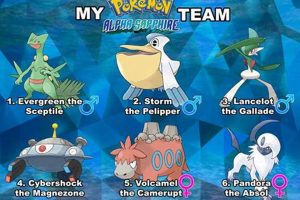



A successful competitive Pokmon team in Pokmon Showdown, a popular online battle simulator, embodies strategic synergy and optimized individual Pokmon builds. This collective unit is constructed to effectively counter prevalent threats and capitalize on common weaknesses found within the metagame. For example, a team might include a dedicated hazard setter, a powerful wallbreaker, and a fast sweeper to cover various offensive and defensive needs.
Developing a high-performing unit offers several key benefits. It allows players to consistently climb the ladder, participate effectively in tournaments, and refine their understanding of competitive battling strategies. Historically, teams have evolved in response to shifts in the metagame, new Pokmon releases, and adjustments to game mechanics. The composition and strategy of leading teams serve as benchmarks for competitive players.
Subsequent sections will delve into crucial aspects of team building, including understanding the metagame, selecting core members, identifying synergistic partnerships, and optimizing individual Pokmon move sets and item choices. We will also explore common team archetypes and provide examples of successful compositions.
Team Construction Strategies
The following guidelines outline key considerations for building an effective competitive Pokmon team in Pokmon Showdown. Attention to detail and adaptation to the evolving metagame are paramount.
Tip 1: Analyze the Metagame: A thorough understanding of prevalent Pokmon, common strategies, and popular team compositions is crucial. Analyze usage statistics and recent tournament results to identify key threats and opportunities.
Tip 2: Define a Core: Identify two or three Pokmon that synergize well and form the foundation of the team. This core should ideally cover each other’s weaknesses and provide a consistent offensive or defensive presence. For instance, a Fire/Water/Grass core provides broad coverage.
Tip 3: Address Type Weaknesses: Ensure the team possesses sufficient coverage to effectively deal with all type matchups. Avoid stacking multiple weaknesses to common offensive types, such as Electric or Ground.
Tip 4: Incorporate Hazard Control: Entry hazards like Stealth Rock and Spikes can significantly impact battle outcomes. Include a Pokmon capable of setting hazards or removing them from the team’s side of the field using moves like Rapid Spin or Defog.
Tip 5: Provide Speed Control: Outspeeding opposing Pokmon is often critical for securing knockouts or setting up strategies. Implement options for speed control, such as Choice Scarf users, priority moves, or moves that lower the opponent’s speed.
Tip 6: Optimize Move Sets: Select moves that maximize coverage, utility, and damage output. Consider the specific role of each Pokmon within the team and choose moves that complement its strengths and mitigate its weaknesses.
Tip 7: Consider Item Choice: The selection of held items can significantly impact Pokmon performance. Choice items boost a single stat, while Life Orb increases damage output at the cost of health. Leftovers provides passive healing, and various berries offer situational advantages.
Tip 8: Practice and Refine: Regularly test the team in battles and identify areas for improvement. Adjust move sets, item choices, or team composition as needed based on performance and evolving metagame trends.
By applying these principles, players can enhance their chances of success in Pokmon Showdown and achieve a higher level of competitive play.
The following section will present specific examples of successful team archetypes and their underlying strategies.
1. Synergy

Synergy, in the context of competitive Pokmon Showdown teams, refers to the beneficial interactions between individual Pokmon. A cohesive unit requires more than just powerful individual members; it demands that their strengths complement each other while mitigating shared weaknesses. Team building without proper synergy invariably leads to inconsistent performance and vulnerability to specialized strategies.
- Type Coverage Synergy
This facet involves selecting Pokmon types that cover each other’s weaknesses offensively and defensively. A Fire-Water-Grass core, for instance, provides broad resistance to common attack types and offers super-effective damage against a wide range of opposing Pokmon. Failing to achieve adequate type synergy leaves the team exposed to exploitation by specific offensive types.
- Ability Synergy
Specific Abilities, when combined, can create powerful strategic advantages. For example, a Pokmon with Drought (summoning harsh sunlight) can boost the power of Fire-type moves for allies, while another Pokmon with Chlorophyll benefits from increased Speed in sunlight. These interactions amplify the effectiveness of individual Pokmon and create a synergistic offensive pressure.
- Move Set Synergy
Carefully chosen move sets can create opportunities for team members. A Pokmon using Sticky Web to lower opponents’ Speed provides a significant advantage for slower, powerful sweepers. Similarly, a Pokmon setting up entry hazards like Stealth Rock weakens opponents switching into battle, creating opportunities for teammates to secure knockouts.
- Role-Based Synergy
Effective teams often allocate specific roles to individual Pokmon, such as wallbreakers, sweepers, and support units. These roles must work together seamlessly. A wallbreaker can eliminate defensive threats, paving the way for a sweeper to capitalize on weakened opponents. A support unit provides status control and hazard removal, ensuring the team’s overall stability.
The culmination of these synergistic elements defines the success of a Pokmon Showdown team. A team with exceptional individual components but lacking in synergistic interaction will often struggle against a well-coordinated team with lesser, but better-integrated, components. Mastering the art of building synergistic teams is therefore paramount to achieving consistent success in competitive Pokmon battles.
2. Coverage

Coverage, in the context of crafting a high-performing Pokmon Showdown team, refers to the team’s ability to effectively address a wide range of opposing Pokmon types and strategies. A team lacking adequate coverage is inherently vulnerable to specific threats, regardless of the individual strength of its constituent Pokmon. Effective teams are built to withstand and overcome diverse offensive and defensive approaches.
Insufficient coverage represents a critical weakness in team building. For example, a team heavily reliant on Water-type attacks will struggle significantly against teams with multiple Grass-type Pokmon or those employing Water Absorb. Similarly, a team lacking a reliable answer to common threats such as Ferrothorn or Toxapex is likely to face considerable challenges in competitive play. Teams often include moves with diverse coverage to hit common threats. Earthquake is a Ground-type move and provides excellent coverage against Steel, Rock, Electric, Fire and Poison types, and thus may be beneficial for a team lacking effective coverage against them.
In summary, coverage is an indispensable aspect of building a competitive Pokmon Showdown team. It enables the team to navigate a diverse metagame and effectively counter prevalent threats. Neglecting coverage leaves the team susceptible to exploitation, hindering its ability to achieve consistent success. Balancing coverage with synergy and offensive prowess is paramount to constructing a robust and versatile team.
3. Resilience

Resilience, in the context of Pokmon Showdown, represents a team’s capacity to withstand unfavorable situations, recover from setbacks, and maintain effectiveness throughout a battle. A resilient team possesses the ability to endure sustained offensive pressure, status conditions, and unfavorable type matchups without collapsing. Its relevance to building a successful competitive team cannot be overstated.
- Defensive Typing and Bulk
A resilient team typically features Pokmon with favorable defensive typings and sufficient bulk (HP, Defense, Special Defense) to absorb damage. Pokmon with resistances to common offensive types, such as Steel, Water, or Fairy, provide a defensive backbone. Investing in defensive stats allows these Pokmon to survive powerful attacks and remain functional even under pressure. Without adequate defensive typing and bulk, a team is susceptible to being overwhelmed by strong offensive threats.
- Status Condition Mitigation
Status conditions like paralysis, burn, poison, and sleep can severely cripple a team’s offensive and defensive capabilities. Resilient teams incorporate strategies to mitigate the impact of these conditions. This may include using Pokmon with abilities that prevent status, employing moves like Heal Bell or Aromatherapy to cure the team, or utilizing items like Lum Berry or Chesto Berry to provide temporary immunity. A team vulnerable to status is prone to being stalled out or losing key members due to debilitating effects.
- Recovery Options
The ability to recover lost HP is crucial for sustaining a team’s longevity. Resilient teams include Pokmon with access to reliable recovery moves, such as Recover, Synthesis, or Soft-Boiled. Leftovers, a held item that provides passive healing each turn, is also a common choice. The presence of recovery options allows Pokmon to withstand repeated attacks and maintain their effectiveness throughout the battle. A team lacking recovery is quickly worn down by attrition.
- Strategic Switching and Pivoting
Resilient teams excel at strategic switching to gain type advantages, absorb incoming attacks, and reposition their Pokmon effectively. Utilizing moves like U-Turn or Volt Switch allows for safe switches while maintaining offensive momentum. Anticipating opponent’s moves and switching to a more favorable matchup is a hallmark of resilient play. A team that cannot effectively pivot is easily predicted and exploited.
These facets of resilience are crucial for crafting a competitive Pokmon Showdown team capable of enduring the rigors of battle. A team that prioritizes defensive stability, status mitigation, recovery, and strategic switching is better positioned to weather unfavorable circumstances and emerge victorious. Resilience, when combined with offensive pressure and strategic synergy, forms the foundation of a successful team.
4. Offense

Offense constitutes a critical element of any competitively viable Pokmon Showdown team. A team lacking sufficient offensive presence struggles to apply pressure, secure knockouts, and ultimately control the pace of the battle. Effective offense encompasses more than just raw power; it requires strategic planning, type coverage, and the ability to exploit opponent vulnerabilities.
The selection of offensive Pokmon and moves dictates a team’s capacity to pressure the opponent. A balanced offensive approach incorporates a mix of wallbreakers (Pokmon capable of breaking through defensive walls), sweepers (Pokmon designed to capitalize on weakened opponents and secure multiple knockouts), and potential setup sweepers (Pokmon that boost their stats to overwhelm the opponent), each filling distinct offensive roles. For example, a powerful wallbreaker like Choice Banded Tyranitar can eliminate threats like Toxapex, paving the way for a sweeper like Mega Lopunny to clean up the remaining Pokmon. Offensive movesets must also consider type coverage, ensuring the team can hit a wide range of opponents for super effective damage. Failure to adequately consider these aspects results in a team that struggles to break through defensive cores or capitalize on offensive opportunities, thus decreasing their chances of success. This is directly opposed to the term best pokemon showdown team
In conclusion, offense is indispensable for success in Pokmon Showdown. A balanced offensive approach, strategic move selection, and the ability to exploit opponent weaknesses are crucial for securing victories. Neglecting the offensive capabilities of a team inevitably hinders its competitive potential, undermining its ability to control the battle’s flow and capitalize on opportunities to secure knockouts, the exact opposite of what the best pokemon showdown team is supposed to do. Teams need to have a strategy, and offensive presence is a cornerstone of successful team design.
5. Support

In the creation of a competitive Pokmon Showdown team, the concept of ‘Support’ constitutes a vital component, influencing the team’s overall effectiveness and ability to execute its strategies. It encompasses the various roles and functions that facilitate the success of offensive and defensive core members, ensuring their optimal performance in battle. Understanding and implementing adequate support is crucial for maximizing a team’s potential and achieving consistent results.
- Hazard Control
Entry hazards, such as Stealth Rock, Spikes, Toxic Spikes, and Sticky Web, exert significant influence on battle outcomes. Support-oriented Pokmon often possess the ability to set these hazards on the opponent’s side of the field or remove them from their own. Hazard setters can cripple opposing switch-ins, while hazard removers like Rapid Spin or Defog safeguard the team from taking unnecessary damage. These measures indirectly help secure the advantage of team member. The presence of hazard control significantly enhances the team’s resilience and offensive pressure.
- Status Condition Infliction and Removal
Status conditions, including paralysis, burn, poison, and sleep, can severely hinder the opponent’s ability to function effectively. Support Pokmon may inflict these conditions on key targets, disrupting their strategies and creating opportunities for teammates to capitalize. Conversely, they may possess moves like Heal Bell or Aromatherapy to cure status ailments affecting their own team. Status control is essential for maintaining momentum and preventing crucial members from being incapacitated.
- Clerical Support
Clerical support covers moves that heal teammates. Wish and Healing Wish grant safe opportunities to allow team members to heal, increasing their longevity and likelihood to assist in future battles. Heal Bell and Aromatherapy, mentioned above in terms of removal of status aliments, fall under the category of Clerical support due to its helpfulness for all team members.
- Pivoting and Momentum Control
Support Pokmon often possess moves like U-Turn or Volt Switch, allowing them to switch out to a more favorable matchup while maintaining offensive pressure. These moves enable the team to control the flow of battle, gain type advantages, and reposition their members strategically. Slow U-Turns can safely bring in frailer team members that may otherwise not be able to come into play. This creates opportunities for the offensive core to exploit weaknesses and secure knockouts, thus contributing to the overall success of the team.
The integration of these support elements significantly enhances the effectiveness of a competitive Pokmon Showdown team. Support roles are therefore fundamental to building a successful and balanced team capable of thriving in the dynamic and demanding landscape of competitive Pokmon.
6. Prediction

Effective prediction is intrinsically linked to the construction of a top-tier Pokmon Showdown team. Anticipating an opponent’s likely actions, such as switches, move choices, and strategic setups, allows for proactive counter-measures and the exploitation of vulnerabilities. The ability to accurately forecast these actions directly influences the success of individual plays and the overall trajectory of a match. A teams design must, therefore, account for the predictive element of high-level play.
For example, if an opponent consistently switches a specific Pokmon into a particular threat, anticipating this switch and selecting a super-effective attack can secure a significant advantage. Similarly, recognizing patterns in an opponent’s move selection allows for the use of Protect or Substitute to avoid damage and gain momentum. Team composition itself can be influenced by predictive elements; if a particular strategy is prevalent in the metagame, a successful team will incorporate measures to counter it. Without prediction, even a team with strong individual components and type coverage will struggle against skilled opponents who consistently outmaneuver them. Consider a team with a setup sweeper that is reliant on boosting its stats; a player adept at prediction might anticipate this setup and use Haze or a phazing move to reset the sweeper’s stats and disrupt their strategy.
In summary, prediction is not merely a skill for individual battles, but a fundamental component that shapes the design and effectiveness of any team aspiring to be considered among the best in Pokmon Showdown. Understanding and incorporating predictive elements into team building significantly enhances the ability to control the flow of battle, exploit opponent tendencies, and secure victories. Neglecting this aspect leaves a team vulnerable to skilled opponents who can anticipate and counter their every move. Therefore, the teams that achieve the label of the best pokemon showdown team do so, in part, because of the ability to incorporate and plan for prediction in battles.
Frequently Asked Questions
The following section addresses common inquiries regarding the construction and optimization of competitive Pokmon Showdown teams. The aim is to provide clarity and guidance on key aspects of team building, targeting common challenges faced by players seeking to improve their competitive performance.
Question 1: What constitutes a balanced team composition?
A balanced team typically incorporates a combination of offensive and defensive roles, ensuring coverage against a wide range of threats. This often includes a dedicated wallbreaker, a fast sweeper, a reliable defensive pivot, and dedicated hazard control. The specific composition varies based on the metagame and intended strategy, but a lack of balance can leave the team vulnerable to exploitation.
Question 2: How important is type synergy in team construction?
Type synergy is paramount. A team lacking type synergy suffers from inherent weaknesses that can be easily exploited. Careful consideration of type matchups, resistances, and immunities is crucial to ensure the team can withstand diverse offensive pressures and maintain a defensive presence.
Question 3: What is the role of entry hazards, and how should they be addressed?
Entry hazards, such as Stealth Rock and Spikes, significantly impact battle outcomes by weakening opposing Pokmon upon switching in. Teams should incorporate methods to set these hazards on the opponent’s side of the field or remove them from their own using moves like Rapid Spin or Defog, thus controlling the field.
Question 4: What are the most common mistakes in team building?
Common pitfalls include neglecting type coverage, failing to account for prevalent threats in the metagame, overlooking the importance of speed control, and lacking a cohesive strategy. Addressing these mistakes significantly enhances a team’s overall effectiveness.
Question 5: How does the metagame influence team construction?
The metagame, defined by popular Pokmon and strategies, directly influences team composition. Adapting to the metagame by incorporating counters to prevalent threats is essential for success. Teams built in isolation, without consideration for the metagame, often struggle against established archetypes.
Question 6: How often should a team be revised or updated?
Team revisions should occur periodically in response to shifts in the metagame, new Pokmon releases, or adjustments to game mechanics. Continuous refinement is essential to maintain a competitive edge and adapt to the evolving landscape of Pokmon Showdown.
In summary, successful Pokmon Showdown team building requires a comprehensive understanding of various factors, including type synergy, metagame trends, and strategic roles. Addressing common mistakes and continuously refining team compositions are crucial for sustained success.
The subsequent section will explore practical examples of successful team archetypes and their underlying strategies, providing a deeper understanding of competitive team building principles.
The Pursuit of a Dominant Pokmon Showdown Team
The creation of a team optimized for competitive Pokmon Showdown demands careful consideration of numerous interdependent factors. This examination explored key elements, including synergy, coverage, resilience, offense, support, and prediction, each of which contributes significantly to a team’s overall effectiveness. A truly successful composition requires a delicate balance across these areas, adapted to the ever-shifting metagame. The construction of a best pokemon showdown team involves continuous analysis, adaptation, and refinement.
Mastery of team building is a process requiring dedication and a commitment to understanding the nuances of competitive battling. While the pursuit of the best pokemon showdown team is a perpetual endeavor, the principles outlined serve as a foundation for players seeking to achieve a higher level of competitive proficiency and secure consistent victories.


![Build the Best AAA Team Pokemon Showdown [Guide] | Pokémon Guide & Updates – Latest News, Games, Cards, and Tips](https://pokepolitan.com/wp-content/uploads/2026/02/th-53-300x200.jpg "Build the Best AAA Team Pokemon Showdown [Guide] Pokémon Guide & Updates – Latest News, Games, Cards, and Tips")