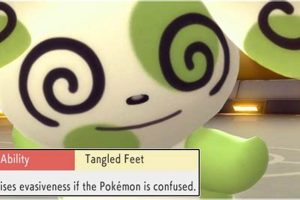



The characteristic in question refers to a specific ability possessed by certain Pokmon, rendering them immune to infatuation, taunt, and intimidation effects. For example, a Pokmon with this ability cannot be affected by the move “Attract,” which would normally cause the afflicted Pokmon to become infatuated and occasionally unable to attack. This immunity extends to moves like “Taunt,” preventing the Pokmon from using status moves, and abilities like “Intimidate,” which lowers the Attack stat of the opponent upon entry into battle.
The strategic value lies in nullifying common disruption tactics employed by opposing trainers. This allows a trainer to reliably execute their strategy without the interruption of status ailments or stat debuffs. Historically, this immunity has been a niche but useful asset in competitive battling, particularly in countering predictable or common strategies focused on status conditions. The availability of Pokmon possessing this characteristic can influence team composition and battle planning.
Understanding this defensive capability is crucial when formulating battle strategies and predicting opponent actions. Subsequent sections will delve into specific Pokmon that possess it, its effectiveness against various strategies, and its role within the broader competitive landscape. This knowledge provides a tactical advantage in both casual and competitive Pokmon battles.
Strategic Applications and Considerations
This section outlines practical advice for utilizing the aforementioned Pokémon ability effectively, considering its strengths and limitations in various combat scenarios.
Tip 1: Team Composition: When building a team, consider including at least one Pokémon with this ability to serve as a countermeasure against status-reliant opponents. This provides a safety net against unexpected tactical disruptions.
Tip 2: Predicting Opponent Actions: Anticipate when an opponent might attempt to use moves such as “Attract” or “Taunt.” Switching in a Pokémon with this ability at the opportune moment can completely negate their strategy.
Tip 3: Ability Synergy: Combine this ability with other defensive abilities or held items to create a resilient Pokémon capable of withstanding a variety of attacks. For instance, pairing it with a held item that boosts Special Defense can create a particularly difficult-to-defeat special wall.
Tip 4: Countering Intimidation: The immunity extends to the “Intimidate” ability, often possessed by physically offensive Pokémon. Utilizing a Pokémon with this ability can prevent the Attack stat reduction, allowing for a more potent offensive presence.
Tip 5: Movepool Coverage: Ensure that the Pokémon in question possesses a diverse movepool. Relying solely on its ability to negate status moves can leave it vulnerable to direct attacks or other strategies.
Tip 6: Identifying Priority Targets: Determine which opponent Pokémon are most likely to utilize status moves or Intimidate. Prioritizing these targets for switch-ins or direct attacks can maximize the effectiveness of this ability.
By understanding these tactical considerations, trainers can effectively leverage this inherent defensive capability to gain a competitive edge in Pokémon battles.
The subsequent section will explore specific matchups where this ability proves particularly advantageous, offering detailed examples and analysis.
1. Status Immunity

Status immunity, a defining characteristic, directly correlates with the ability observed in certain Pokmon. This immunity shields them from various debilitating conditions, ensuring consistent functionality in battle and forming a cornerstone of their strategic utility. Its implications extend beyond simple condition prevention, influencing team composition and battle strategy.
- Paralysis Resistance
Paralysis, typically induced by Electric-type moves, reduces Speed, crippling offensive potential. A Pokmon resistant to paralysis maintains its speed advantage, ensuring it can outspeed and potentially defeat opponents reliant on quick strikes. The ability to resist this condition safeguards against a common tactic used to control the pace of battle.
- Burn Prevention
Burn, inflicted by Fire-type attacks, gradually reduces a Pokmon’s HP each turn. This persistent damage can significantly weaken a physical attacker over time. The capacity to prevent burn ensures the Pokmon’s sustained offensive capability, especially crucial in longer battles.
- Poison Negation
Poison and its more potent variant, Toxic, inflict increasing damage each turn. This escalating damage can rapidly deplete a Pokmon’s health, forcing a switch or leading to defeat. The inherent resistance to poison allows the Pokmon to remain in battle longer, sustaining its role without succumbing to attrition.
- Sleep Avoidance
Sleep incapacitates a Pokmon for multiple turns, rendering it vulnerable to attacks. While asleep, a Pokmon cannot act, granting the opponent free turns to set up or inflict significant damage. Avoiding sleep ensures the Pokmon’s immediate availability for battle, preventing exploitation by sleep-inducing strategies.
These facets collectively highlight the strategic importance of status immunity. By negating these common and disruptive conditions, Pokmon with this ability maintain consistent performance, providing reliable support or offense. This defensive advantage allows for more predictable battle outcomes and enhances overall team resilience against status-reliant opponents.
2. Taunt Negation

Taunt negation is a direct consequence of possessing the Pokémon ability, removing its otherwise disruptive influence in battle. “Taunt” is a move that forces an opponent to only use attacking moves, preventing the use of status, support, or setup moves. The ability overrides this effect completely. This interaction fundamentally alters the strategic landscape, allowing Pokémon possessing this ability to execute their pre-determined battle plans without interruption. For example, a defensive Pokémon intending to set up entry hazards like Stealth Rock or Toxic Spikes is normally vulnerable to “Taunt.” The ability eliminates this vulnerability, ensuring the reliable deployment of these strategic advantages. The importance lies in maintaining control over battle flow and denying the opponent the opportunity to disrupt strategic setups.
The practical significance extends to competitive battling. Strategies reliant on moves such as Baton Pass, which transfers stat boosts to another Pokémon, or recovery moves like Recover, are often shut down by “Taunt.” A Pokémon inherently resistant to “Taunt” can thus maintain momentum and sustain its presence in battle. A real-world example would be a Calm Mind user setting up Special Attack and Special Defense boosts, unimpeded by the opponent’s attempts to prevent this setup via “Taunt,” ultimately leading to a powerful offensive threat. This allows for more diverse and potentially devastating strategies to be employed without fear of common counter-measures.
In summary, the inability to be affected by the Taunt move greatly enhances their utility in battles by guaranteeing the execution of planned moves. This benefit is significant in various strategic scenarios, ensuring that the defensive capabilities and tactical advantages it provides remain consistent. Furthermore, understanding this connection allows trainers to adapt their strategies, creating more resilient and adaptable teams in both casual and competitive settings.
3. Intimidation Block

The relationship between “Intimidation Block” and the designated Pokémon ability is direct and consequential. The ability inherently grants immunity to the “Intimidate” ability, which reduces the Attack stat of opposing Pokémon upon entering the battle. This interaction constitutes the “Intimidation Block.” The importance of this block stems from its preservation of offensive potential. Without it, physically offensive Pokémon would suffer an immediate handicap, diminishing their effectiveness. For instance, a powerful physical attacker entering the field against a Pokémon with “Intimidate” would normally experience a significant Attack stat reduction. The ability prevents this, maintaining its offensive prowess and allowing it to function as intended. This dynamic underscores the strategic value of “Intimidation Block” as a fundamental component of the ability itself.
The “Intimidation Block” provides significant tactical flexibility. It allows trainers to reliably deploy physical attackers without fear of immediate stat reduction, streamlining team composition and battle planning. An example would be using a strong fighting type attacker against a common normal type. The resistance to intimidate ability grants the user a tactical advantage allowing the user to deliver its move effectively. In competitive environments, where predicting opponent strategies is crucial, the “Intimidation Block” offers a degree of certainty. By negating this common tactic, trainers can focus on other aspects of the battle, such as move selection and type matchups, with a reduced risk of unexpected stat manipulation. This reliability directly translates to increased consistency in battle performance.
In summary, the “Intimidation Block” is not merely a secondary effect but an integral part of the tactical value of the designated Pokémon ability. It ensures that physical attackers can consistently deliver their intended damage output, provides tactical flexibility in team building, and contributes to overall battle predictability. While challenges remain in utilizing this ability effectivelysuch as predicting opponent team compositions and choosing appropriate move setsthe “Intimidation Block” remains a significant asset in a trainer’s strategic arsenal, consistent with the larger themes of strategic battle applications.
4. Infatuation Prevention
Infatuation prevention is a direct and inherent function of the ability present in certain Pokémon. The “Attract” move, which causes the infatuation status, is rendered entirely ineffective. This immunity is not merely a side benefit, but a core component of the ability’s design and strategic purpose. The cause-and-effect relationship is simple: the ability directly negates the “Attract” move’s effect. The importance of infatuation prevention lies in maintaining a Pokémon’s operational capacity. Infatuation introduces a chance that a Pokémon will be unable to attack each turn, severely hindering its reliability. For example, a powerful offensive Pokémon afflicted with infatuation may be rendered useless for several turns, allowing an opponent to gain a significant advantage. The ability removes this element of chance, ensuring consistent performance. The practical significance is clear: preventing infatuation allows for the predictable execution of battle strategies.
Consider a team strategy reliant on a specific Pokémon to deal consistent damage or provide crucial support. Infatuation would introduce an unacceptable level of risk. A switch-in might be forced, or the strategy entirely compromised. The ability nullifies this threat, allowing the team composition to function as intended. Furthermore, the prevalence of “Attract” in the competitive metagame necessitates a countermeasure. While other methods exist, such as switching out the afflicted Pokémon, the ability provides a passive and reliable defense, freeing up resources and strategic options. The ability, therefore, is not simply a niche advantage, but a practical safeguard against a widely used tactic.
In summary, infatuation prevention is an essential and integrated aspect of the specified Pokémon characteristic. Its role is not merely to resist a specific move, but to ensure consistent performance and strategic reliability in battle. While trainers still face numerous challenges in team building and battle execution, this specific form of immunity provides a tangible and predictable advantage in any competitive setting.
5. Strategic Resilience
Strategic resilience, in the context of certain Pokémon, is directly enhanced by the ability under consideration. The inherent immunities grantedto infatuation, taunt, and intimidationcollectively contribute to a Pokémon’s capacity to withstand strategic disruption. The cause-and-effect relationship is that, by negating specific status conditions and stat-altering effects, the ability allows a Pokémon to maintain its intended function within a battle strategy. The importance of strategic resilience as a component is that it allows for greater team reliability. For example, a Pokémon designed as a defensive wall or a setup sweeper can perform its role without the interruption of common tactical maneuvers. This increases the overall consistency and predictability of a battle plan.
The practical significance of understanding the resilience conferred by this ability extends to team construction and battle planning. Trainers can more reliably incorporate these Pokémon into complex strategies, knowing that they are less vulnerable to certain forms of disruption. In competitive settings, where opponents actively seek to exploit vulnerabilities, the capacity to resist tactical interference is invaluable. For instance, a team intending to utilize Baton Pass chains can benefit significantly from including Pokémon resistant to taunt, ensuring the execution of their strategy even against opponents specifically targeting this tactic. The inherent immunity fosters a greater level of strategic certainty, allowing trainers to focus on other aspects of the battle.
In conclusion, strategic resilience is not merely a consequence, but a defining feature of Pokémon possessing the specific immunity. It ensures operational consistency, enhances team reliability, and provides a critical advantage in competitive battles. While challenges remain in effectively deploying these Pokémonsuch as predicting opponent team compositions and adapting to unforeseen circumstancesthe resilience they offer remains a valuable asset in any trainer’s arsenal. The ability to maintain strategic cohesion in the face of adversity constitutes a distinct advantage in the complex landscape of Pokémon battles.
Frequently Asked Questions
The following addresses frequently encountered questions regarding the Oblivious ability in Pokémon. Clarification of its mechanics and strategic implications is provided below.
Question 1: Does the Oblivious ability provide complete immunity to all status conditions?
No. The Oblivious ability only prevents infatuation, taunt, and intimidation. It does not prevent other status conditions such as paralysis, burn, poison, sleep, or freeze.
Question 2: Is the Oblivious ability effective against abilities like Cute Charm?
Yes. The Oblivious ability prevents infatuation, regardless of the source. Therefore, a Pokémon with this ability will not become infatuated by a Pokémon with the Cute Charm ability.
Question 3: Does the Oblivious ability block stat reductions from moves other than Intimidate?
No. The Oblivious ability only prevents the Attack stat reduction caused by the Intimidate ability. It does not prevent stat reductions caused by moves such as Growl or moves with secondary stat-reducing effects.
Question 4: Can the Oblivious ability be copied or swapped by abilities like Trace or Skill Swap?
Yes. The Oblivious ability can be copied by abilities like Trace and swapped by abilities like Skill Swap. The functionality of the copied or swapped ability remains consistent.
Question 5: Is the Oblivious ability negated by abilities like Mold Breaker, Teravolt, or Turboblaze?
No. The Oblivious ability provides immunity to specific effects, not a barrier that can be broken through by abilities like Mold Breaker, Teravolt, or Turboblaze. The targeted moves/abilities simply fail when directed towards the affected Pokémon.
Question 6: Does the Oblivious ability have any effect outside of battle, such as in the overworld?
In some Pokémon games, a Pokémon with the Oblivious ability at the head of the party may prevent wild Pokémon with higher levels from approaching the player.
In summary, the Oblivious ability provides specific and limited immunities, primarily related to infatuation, taunt, and intimidation. Understanding these limitations is crucial for effective strategic application.
The following section will delve into specific Pokémon that possess the ability, along with their corresponding strengths and weaknesses.
Conclusion
The preceding analysis has thoroughly examined the Pokémon ability described by the term “pokemon oblivious.” Its core function involves immunity to specific disruptive conditions: infatuation, taunt, and intimidation. The strategic value of “pokemon oblivious” lies in its capacity to maintain consistent performance in the face of common tactical maneuvers. Team composition, predictive play, and ability synergy are crucial considerations for effective implementation of Pokémon possessing this trait. Specific matchups, such as those involving Intimidate-reliant opponents, highlight its advantages. The ability’s scope is limited, not extending to all status conditions or stat-altering effects, requiring careful consideration during strategic planning.
The ability is a tool that contributes to overall strategic depth, demanding nuanced understanding and precise application. The future of competitive Pokémon battling will undoubtedly witness continued evolution in its utilization, contingent upon metagame shifts and the introduction of new abilities and moves. Therefore, a continuous assessment of its strengths and weaknesses is paramount for any trainer seeking to optimize their battle strategy.