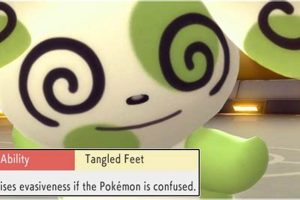



The ability enhances a Pokmon’s Speed stat by 50% when afflicted with a status condition, such as poison, burn, paralysis, freeze, or sleep. This stat boost activates only when the Pokmon is suffering from one of these ailments, effectively turning a disadvantage into an advantage. A practical example is a Pokmon intentionally inflicted with a Toxic Orb, activating the Speed boost at the cost of gradual poison damage, potentially outpacing opponents.
This capability provides a significant tactical advantage, allowing Pokmon to outspeed opponents who might otherwise move first. Its value lies in its ability to turn a debilitating status condition into a beneficial stat increase, opening up strategic options such as utilizing status-inducing items or moves on oneself to trigger the Speed boost. Historically, this ability has seen use in competitive battling, offering a unique approach to Speed control and offensive pressure.
The following sections will delve into specific strategies for utilizing this ability, including optimal item pairings, move sets, and team compositions designed to maximize its effectiveness. Further discussion will also cover common counters to this strategy and methods for mitigating those threats.
Strategic Application
Maximizing the benefit of the ability requires careful planning and execution. The following tips outline key considerations for effective deployment.
Tip 1: Status Condition Management: Activating the ability requires a status condition. Consider equipping a Toxic Orb or Flame Orb to automatically inflict poison or burn, respectively, upon entering battle. This guarantees activation without relying on opponent actions.
Tip 2: Team Synergy: Integrate the Pokmon with team members capable of inflicting status conditions. Moves like Toxic, Will-O-Wisp, or Thunder Wave can reliably trigger the ability if an item-based solution is not preferred.
Tip 3: Speed Tier Calculation: Precisely calculate the Speed stat after activation to ensure outspeeding intended targets. Use online calculators or team-building tools to optimize EV spreads and natures accordingly.
Tip 4: Baton Pass Support: If applicable, utilize Baton Pass to transfer the Speed boost (and any other beneficial stat boosts) to a more offensively oriented teammate.
Tip 5: Protect Predictably: Opponents may anticipate the activation strategy. Use Protect to scout for moves and potentially waste a turn before committing to an offensive play.
Tip 6: Anticipate Status Removal: Be aware of potential status removal effects from moves like Heal Bell, Aromatherapy, or items like Lum Berry. Have a backup plan if the status condition is removed prematurely.
Tip 7: Consider Sleep Talk: If utilizing sleep as the triggering status, equip Sleep Talk to allow the Pokmon to act even while asleep, mitigating the usual drawbacks of that condition.
Employing these tactics will enhance the effectiveness of the strategy and maximize the offensive potential unlocked by the Speed boost. Understanding potential weaknesses and adapting to opponent strategies are crucial for success.
The concluding section will summarize the advantages and disadvantages of this specific ability and provide guidance on how to integrate it effectively into a competitive team.
1. Status Condition Trigger
The efficacy of this ability hinges entirely on the presence of a status condition. Without a status ailment, the ability remains dormant, offering no benefit to the Pokmon. The status condition serves as the direct trigger, initiating the Speed boost that defines its strategic value. This cause-and-effect relationship is fundamental to understanding its operation. A Pokmon possessing this ability might intentionally induce a status condition, such as through a Toxic Orb, solely to activate the Speed enhancement, effectively leveraging a negative condition for a positive outcome.
The choice of status condition significantly impacts practical application. Paralysis, while halving Speed initially, triggers the Speed boost to offset the reduction. However, the inherent risk of full paralysis remains. Poison or burn, inflicted via Toxic Orb or Flame Orb, provide a more consistent trigger, sacrificing HP for the Speed advantage. Sleep offers a substantial Speed benefit if the Pokmon can utilize Sleep Talk. The selection of a status condition must align with the Pokmon’s role and the team’s overall strategy to optimize performance. For example, a physical attacker might prefer a burn to inflict residual damage and hinder opposing physical attackers.
In summary, the status condition is not merely a prerequisite but an integral component of the ability’s functionality. Its activation is entirely contingent on the presence of a status condition and the status condition selected directly affects the tactical applications. A deep appreciation of this causal link between status and speed is essential for effectively deploying the ability on any team. Countering strategies must revolve around preventing or removing status conditions to neutralize the advantages provided by this ability.
2. Speed Stat Amplification

Speed Stat Amplification is the core mechanism by which the ability creates a tactical advantage. It directly influences a Pokmon’s turn order in battle, allowing it to outpace opponents and execute moves before they can react. The magnitude of this amplification, a 50% increase, is significant and transforms a Pokmon’s battle dynamics.
- Base Speed Thresholds
The effectiveness of the Speed Stat Amplification is predicated on the Pokmon’s base Speed stat. A Pokmon with a naturally high Speed stat will experience a more substantial increase, potentially reaching Speed tiers that would otherwise be unattainable. Conversely, a Pokmon with a low base Speed stat might find the amplified stat still insufficient to outspeed faster threats.
- Nature and EV Investments
A Pokmon’s Nature (e.g., Timid, Jolly) and Effort Value (EV) investment in Speed directly impacts the amplified stat. A Speed-boosting Nature and maximum EV investment synergize with the Speed Stat Amplification, maximizing its potential. Optimal Nature and EV spreads should be calculated to ensure the Pokmon outspeeds specific threats within the metagame.
- Status Condition Synergies
The specific status condition triggering the ability interacts with the Speed Stat Amplification. For instance, if the Pokmon is paralyzed, its Speed is initially halved before the amplification occurs. This necessitates careful planning to ensure that the amplified Speed surpasses that of the intended targets, despite the initial reduction from paralysis.
- Strategic Move Priority
The amplified Speed stat influences the utility of certain moves. Priority moves, such as Quick Attack or Extreme Speed, are generally less valuable on a Pokmon with boosted Speed, as it will likely move first regardless. The amplified Speed allows for greater utilization of powerful, non-priority moves, maximizing offensive output.
In summary, the Speed Stat Amplification is not a simple linear increase but rather a dynamic factor influenced by a combination of base stats, Nature, EV investment, the triggering status condition, and strategic move choices. These elements together determine the extent to which the ability can effectively alter the Pokmon’s battle performance. Understanding these interdependencies is essential for effectively utilizing the ability within a competitive team.
3. Item Synergies

The effectiveness of the ability is significantly influenced by item choices, specifically those that reliably induce status conditions or provide additional strategic advantages. Item selection is not merely complementary but rather integral to activating and sustaining the core benefit of the ability. The most common application involves items that automatically inflict status upon the holder, guaranteeing activation of the Speed boost at the start of battle. A prime example is the Toxic Orb, which poisons the holder, and the Flame Orb, which burns. These items transform the inherent disadvantage of a status condition into an immediate Speed advantage.
Beyond status induction, certain items can further enhance the strategic value. A Lum Berry, for instance, can cure a status condition, potentially mitigating the negative effects while still triggering the Speed boost for one turn before removal. A Choice Band or Choice Specs, though restricting move selection, can augment offensive power, capitalizing on the increased Speed to deliver powerful attacks. Similarly, a Life Orb can boost damage output at the cost of HP, synergizing with the Speed boost for increased offensive pressure. The selection of an appropriate item depends on the Pokmon’s role within the team, its move set, and the intended strategic application. Consider a Pokmon intended to sweep: a Choice Band will often offer better output than a Life Orb because it won’t lose HP.
In conclusion, item synergies are not optional add-ons, but fundamental components of a strategy centered around this ability. By carefully selecting items that reliably induce status conditions or enhance offensive capabilities, the potential of the Speed boost can be fully realized. An understanding of the interplay between item effects, status conditions, and Speed amplification is crucial for maximizing the effectiveness of this ability in competitive battling. The best item for one team and Pokemon might be completely different in a different circumstance.
4. Baton Pass Potential

The ability’s synergy with Baton Pass represents a significant strategic dimension, allowing for the transference of the Speed boost, along with other stat enhancements, to a teammate. This interaction transforms the ability from a self-serving stat increase into a team-oriented tactical advantage. The Pokmon possessing the ability functions as a Speed amplifier, temporarily boosting its own Speed to then pass that benefit to a more offensively potent teammate. This strategy can circumvent the limitations of a Pokmon with a restricted movepool or lower offensive stats, allowing it to contribute to the team’s overall offensive pressure.
Effective implementation of this strategy requires careful team composition and move selection. The Pokmon employing the ability should possess Baton Pass and potentially other stat-boosting moves such as Swords Dance or Agility. The receiving Pokmon should be a powerful sweeper capable of capitalizing on the increased Speed and offensive stats. Consider a scenario where a Scolipede activates the Speed boost through its ability. It then uses Baton Pass to transfer this boost, along with an Agility boost, to a physical sweeper like Garchomp. The Garchomp then gains the necessary Speed to outpace and eliminate threats that would otherwise pose a problem. This chain reaction can create overwhelming offensive momentum.
Baton Pass integration presents challenges, primarily vulnerability to moves like Haze, which reset stat changes, and Taunt, which prevents the use of Baton Pass. Additionally, reliance on Baton Pass can create predictable gameplay, allowing opponents to anticipate and counter the strategy. Despite these risks, the potential for significant Speed advantage and offensive momentum makes it a valuable consideration for competitive team building. Strategic utilization of entry hazards or screen support can help mitigate these vulnerabilities and create opportunities for successful Baton Pass plays, making it important to consider when applying pokemon quick feet.
5. Vulnerability to Removal
The tactical advantage conferred by the ability is inherently susceptible to status removal effects, a significant vulnerability that must be carefully considered when constructing strategies centered around it. The temporary nature of status conditions, and the ease with which they can be cured, renders the Speed boost unreliable in the face of common counter-measures.
- Heal Bell and Aromatherapy
These moves remove all status conditions from the user’s entire party, effectively nullifying the Speed boost gained from the ability. Their widespread availability makes them a common threat, requiring careful prediction and strategic play to mitigate their impact. For example, a well-timed Heal Bell can cripple a team reliant on the Speed boost for offensive momentum.
- Cleric Pokmon
Certain Pokmon, such as Blissey and Chansey, are commonly used for their support capabilities, including status removal. Their presence on the opposing team represents a persistent threat, as they can readily cure status conditions and neutralize the Speed boost, disrupting carefully laid plans. Their high special defense stats make them challenging to eliminate quickly.
- Lum Berry and Chesto Berry
These consumable items cure specific status conditions when held by a Pokmon. A Lum Berry will cure any status ailment, while a Chesto Berry specifically cures sleep. Opponents may equip these berries to thwart attempts to induce status conditions, preventing the Speed boost from activating. Recognizing potential berry usage is crucial for adapting strategy.
- Natural Cure and Shed Skin
These abilities passively cure status conditions upon switching out or under specific conditions, respectively. Natural Cure, for example, automatically removes a status ailment when the Pokmon is switched out of battle. Shed Skin has a chance of curing a status condition at the end of each turn. These abilities render status induction less reliable and necessitate alternative strategies.
The prevalence of status removal effects necessitates strategic flexibility when incorporating the ability into a team. Reliance solely on the Speed boost leaves the team vulnerable to disruption. Diversifying strategic options and incorporating alternative forms of Speed control are crucial for maintaining offensive pressure and mitigating the impact of status removal. Careful prediction and adaptation are essential for navigating the inherent vulnerability to removal when building a team around this ability.
Frequently Asked Questions
The following questions address common points of confusion and misconceptions surrounding this ability. These answers aim to provide clarity for players seeking to understand its mechanics and strategic applications.
Question 1: Does Quick Feet activate when a Pokmon is confused?
Confusion does not trigger the ability. Quick Feet specifically activates in response to paralysis, poison, burn, freeze, or sleep.
Question 2: If a Pokmon with Quick Feet is burned, will the burn damage be reduced?
The ability does not affect the damage inflicted by the burn status condition. The burn damage will still be applied at the end of each turn.
Question 3: Does the Speed boost from Quick Feet stack with other Speed boosts, such as from Agility?
Yes, the Speed boost from Quick Feet is multiplicative and stacks with other Speed boosts. The final Speed stat is calculated after all applicable modifiers have been applied.
Question 4: If a paralyzed Pokmon with Quick Feet is cured of paralysis, does the Speed boost immediately disappear?
Yes, the Speed boost ceases immediately upon removal of the status condition. The Speed stat returns to its base value, modified by any other active boosts or reductions.
Question 5: Does Quick Feet activate if a Pokmon is statused by its own Toxic Orb while holding a Ring Target?
Yes. Because the holder is statused directly by the held item, the trigger for the ability still applies, and the ability will activate.
Question 6: Can Quick Feet be copied by the move Role Play or the ability Trace?
Yes. if Role Play or Trace copies the ability, the effect will occur only when Role Play or Trace Pokemon already is statused.
In summary, understanding the specific triggers and interactions of this ability is crucial for effective deployment. Awareness of common misconceptions allows players to optimize their strategic approaches and avoid miscalculations.
The subsequent section will provide a comparative analysis of this ability against other abilities that influence Speed, highlighting its unique strengths and weaknesses.
Conclusion
The strategic value of the ability, as demonstrated throughout this analysis, hinges on a careful balance between risk and reward. The deliberate infliction of a status condition, the prerequisite for activation, presents inherent drawbacks that must be mitigated through skillful team composition and strategic decision-making. The ability’s vulnerability to status removal necessitates adaptability and alternative strategies. While the potential for significant Speed amplification offers a compelling tactical advantage, its inherent fragility demands meticulous planning and precise execution.
As competitive battling evolves, the viability of ability-centric strategies fluctuates with the metagame. Continued adaptation, exploration of novel item combinations, and innovative team structures are essential for maintaining its relevance. The thoughtful application of this ability, guided by a thorough understanding of its strengths and limitations, will ultimately determine its enduring impact on the competitive landscape. Experimentation and analysis will prove key to unlocking its full potential in the face of ever-evolving challenges.